
Scott County Court Record Requests
Start with the court that handled the case. Scott Circuit Court and Scott Superior Court share one elected clerk. The practical first contact is Michelle Shelton, Scott County Clerk. Use MyCase to find the cause number, court code, case type, and public entries. Treat it as a discovery tool. It is not the official record. A missing document link does not mean a public paper fails to exist.
From there, every channel works: view public information in MyCase, stop at the Clerk's counter, call ahead, or mail or fax a focused request. You can also invoke the Indiana Access to Public Records Act. The Rules on Access to Court Records apply as well. The Clerk posts no dedicated Scott email request address. Ask the office whether electronic delivery is available for your item.
- Identify Scott Circuit or Scott Superior Court and record the cause number.
- Name the exact CCS, order, judgment, pleading, transcript, or recording needed.
- Choose MyCase, counter, phone, mail, fax, or a written public-record request.
- State whether a plain or certified copy is required and ask for the total.
- Confirm the custodian, delivery method, and any stated access restriction.
Scott County Official Court File
The Clerk's file outranks anything on the web. MyCase itself warns that its case information may contain errors or omissions. It may exclude older material. It may show financial figures that lag behind reality. The court-maintained Chronological Case Summary, called the CCS, plus the filed documents form the authoritative Scott County record.
The Indiana electronic-filing provider list helps separate filing from viewing. It names the certified services that work with the Indiana Electronic Filing System.
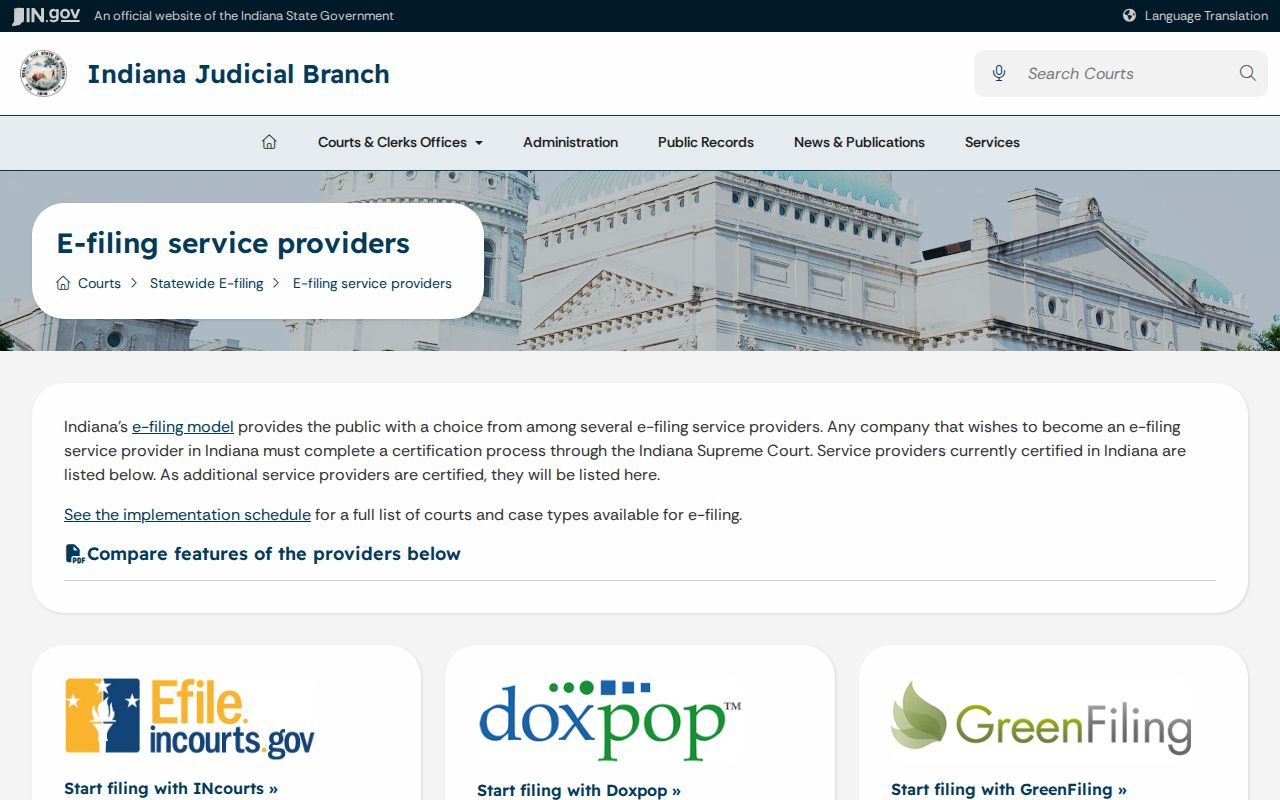
Those providers deliver filings for parties and their lawyers. They do not replace MyCase for public docket searching, nor the Scott County Clerk for an official copy.
Kinds of Scott County Court Records
A Scott County court file can hold far more than its CCS. What sits in it varies with case type, court orders, and access status. Criminal files may put sentencing orders online. Other public papers wait for a Clerk request. Many civil categories allow broader online document access. Family, juvenile, mental-health, adoption, and protection-order material faces much tighter limits.
- CCS entries and hearing settings
- Complaints, charging papers, pleadings, motions, and responses
- Summonses, notices, and public service returns
- Orders, judgments, sentences, dismissals, and satisfaction entries
- Public exhibits, transcripts, recordings, and appeal record material
Scott County court records come in many types. The Indiana document table sets different access rules for case codes like F1 through F6, CM, CF, IF, SC, EV, domestic, juvenile, and estate filings.
Scott County Online Document Limits
The state's document-availability matrix beats any broad claim that records are simply online. Felony criminal categories generally list sentencing orders on the web, for example. Nonconfidential orders and documents appear more widely across several civil and miscellaneous codes. Small-claims records generally offer nonconfidential orders online. The rest of the public file sits at the Clerk's office.
The Indiana public-records page lays out public access and routes for bulk court-data requests.
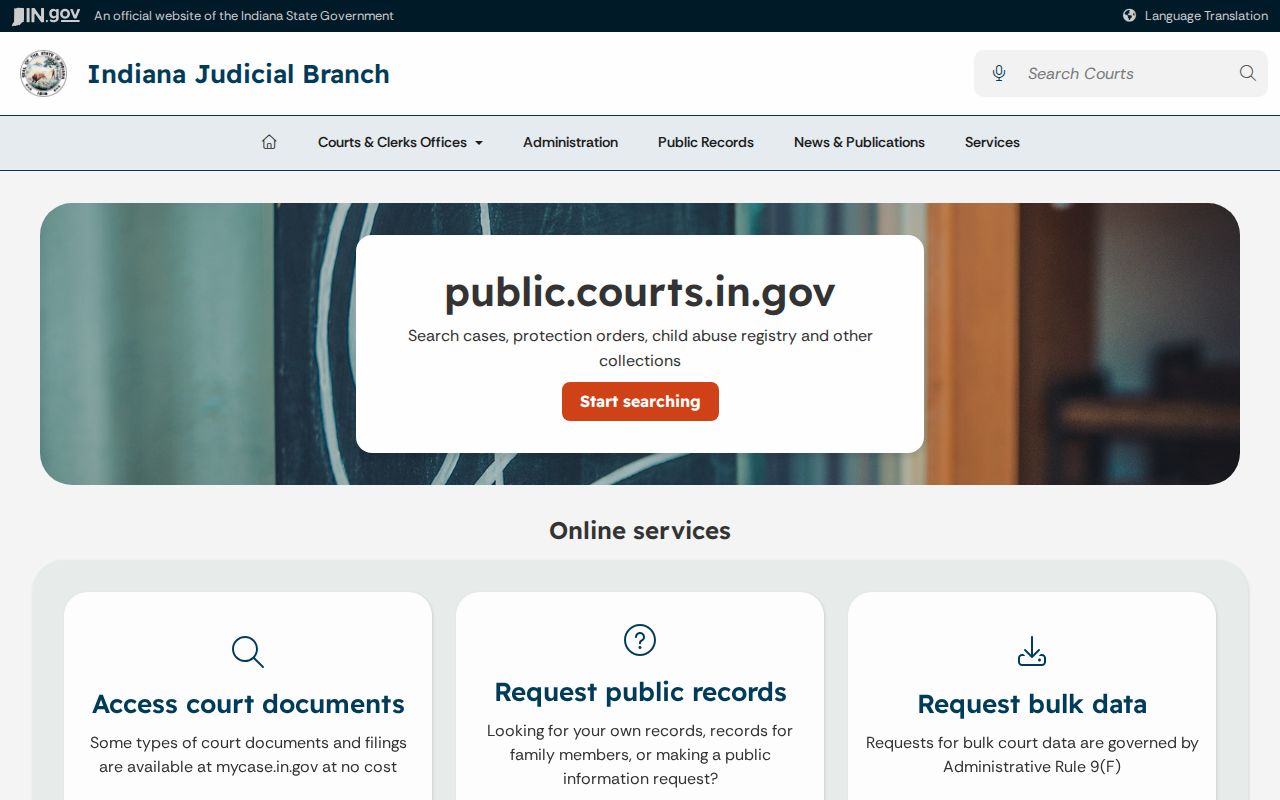
That statewide route matters when a request spans many cases or needs structured data. MyCase caps its results. It is a docket search, not a bulk export service.
Scott County Court Records: Contents
Read each Scott County CCS line according to its label. Not every entry is a downloadable document. A line may record an administrative act, a filed motion, a hearing, a ruling, or a notice. It may also mark a fee, a converted event, or a judgment. A title or link points to an attached paper. An entry without a link can still affect the case.
| Cause Number | Indiana identifier beginning with court code 72C01 or 72D01 for Scott courts. |
|---|---|
| Case Header | Court, case type, filing date, status, and public party roles. |
| CCS Events | Dated actions, filed-by data when public, settings, orders, and results. |
| Documents | Public title, filing date, availability link, or unavailable/confidential signal. |
| Disposition | Judgment, dismissal, sentence, satisfaction, or other final result when public. |
Financial entries may lag behind the true balance. Call the Clerk for a current amount instead of trusting an older web entry.
Scott County Hearing Records
A transcript or hearing recording takes a different path than an ordinary paper copy. Scott local rule LR72-AR15-3 requires a written request, or praecipe, to the court reporter. A praecipe is simply a formal written demand to prepare the record. The electronic court copy is the official one. The local rule sets a maximum ordinary transcript rate of $5.50 per page. Ask about the current total and any different rate before ordering.
Indiana guidance treats qualifying audio and video recordings as court records too. Name the court, cause number, hearing date, and desired format in your request. Ask the maintaining court or reporter about redaction and access. Scott lists no separate recording fee. Get a quote rather than assume the paper-copy rate applies.
Scott County Copy Fees and Certification
A plain copy just reproduces the public record. A certified copy carries the Clerk's formal certification, which recipients often want as proof the copy matches the official file. Clarify whether the certification charge sits on top of page fees. The county page says personal checks are not accepted.
| Scott County item | Published amount |
|---|---|
| Plain court-record copy | $1 per page |
| CCS copy | $1 per page |
| Certified copy charge | $2 |
| Child-support payment history | $1 per page |
Michelle Shelton, Scott County Clerk
1 E McClain Avenue, Suite 120
Scottsburg, IN 47170
Monday through Friday, 8:30 a.m. to 4:30 p.m.
812-752-8420 Fax: 812-752-5459
Precise Scott County Record Requests
A tight Scott County record request moves faster through the clerk's office. The clerk can route a precise ask in minutes. So name the court, the cause number, the case type, and the party caption, plus a rough filing date. Add a reliable way to reach you. Then pin down the public item you want. That may be the CCS through final disposition or a final judgment entered on a known date. Say whether you need a certified copy.
Written requests deserve follow-up questions too. If an item is excluded, unavailable, or held by another office, ask the clerk to explain. Indiana guidance under APRA sets prompt acknowledgment rules. In-person or oral requests get a response or acknowledgment within 24 business hours. Mail, fax, or electronic requests get theirs within seven days. The records themselves can come later. A denial should cite its legal basis and the official who made the call.
Access Rules for Scott County Records
Indiana law presumes that court records are open, but that presumption bends to specific exclusions. Two frameworks work together here. The Indiana Access to Public Records Act is one. The Indiana Rules on Access to Court Records are the other. Rule 4 sets out the general access framework. Rule 5 lists excluded information such as protected identifiers and confidential case categories. Rule 9 governs a verified request asking a court to open an excluded record.
The ACR Rule 4 page displays the general public-access standard.
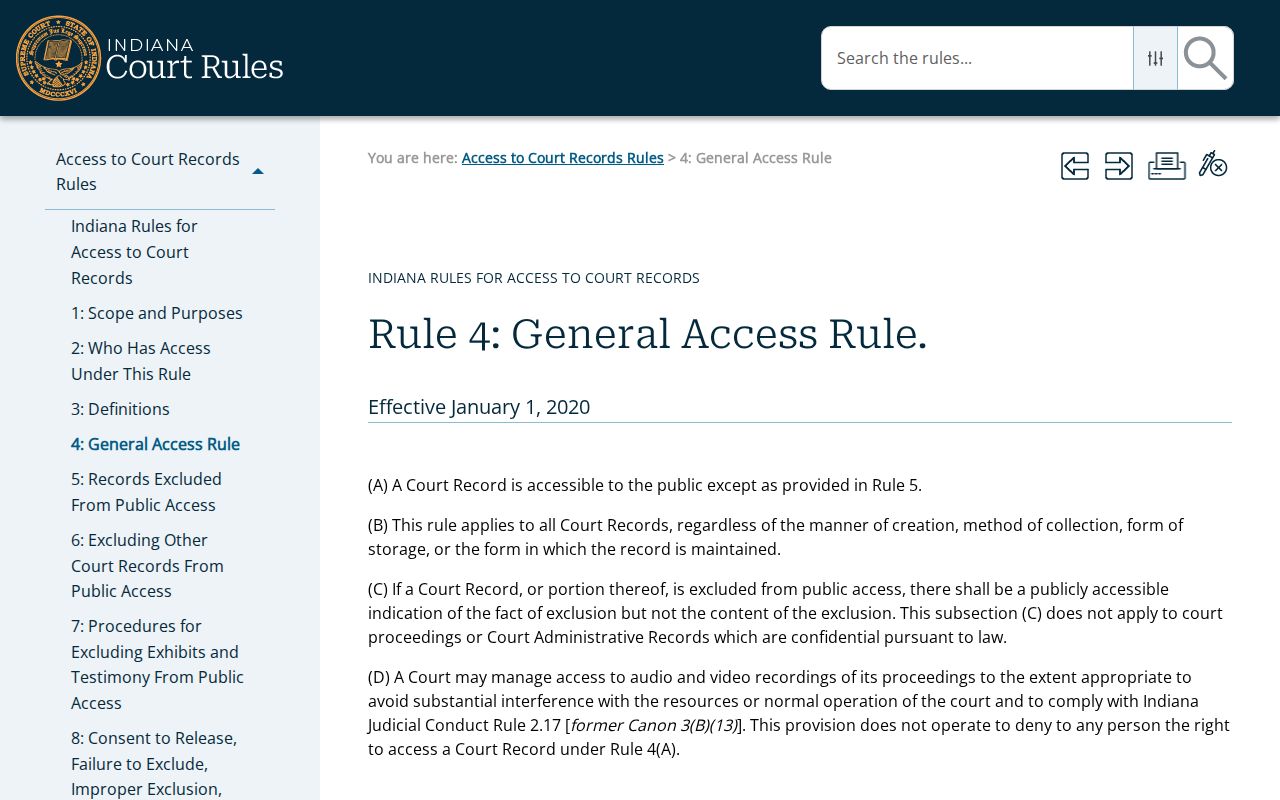
That presumption never overrides a statute, a court order, or a specific exclusion. Access gets assessed one record at a time.
Key Rules: I.C. 5-14-3-3 governs requests and agency responses. I.C. 5-14-3-8 addresses copy fees, and I.C. 5-14-3-9 addresses denials. Indiana ACR Rules 4, 5, and 9 govern court-record access, exclusion, and requests to open excluded records.
Scott County Exclusions and Redactions
Some Scott County court files simply will not be there. Juvenile, mental-health, protection-order, adoption, certain domestic-relations, expunged, sealed, and in-camera materials fall in that group. They may be restricted or absent from the docket. Redactions cover identifiers too. Account numbers, Social Security numbers, passwords, and similar details must never be copied from a filing. A case shell can stay public on the docket. Even then, one document inside it may stay excluded.
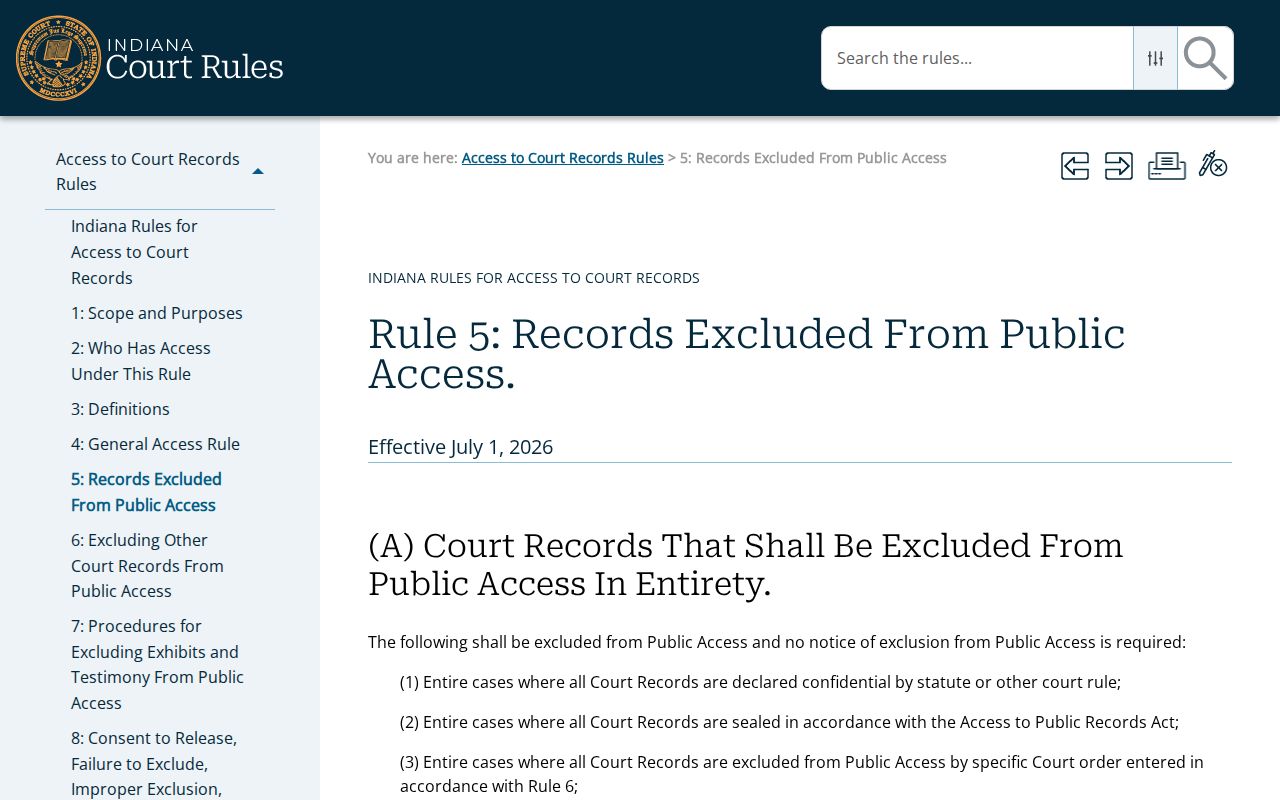
The ACR Rule 5 page identifies exclusion categories and protected information.
Form ACR trips up a lot of people. It is a filer's notice of exclusion, not a public records request form. Anyone seeking an excluded record follows Rule 9 instead.
On the form, the filer lists the court, county, caption, cause number, the excluded document, and the legal ground claimed. The filer then signs it and states a role. Those fields explain why a Scott County CCS can acknowledge an event without publishing its protected attachment. Do not submit Form ACR just to ask for an ordinary nonconfidential copy.
The ACR Rule 9 page sets out the verified request, notice, response, and court-order process.
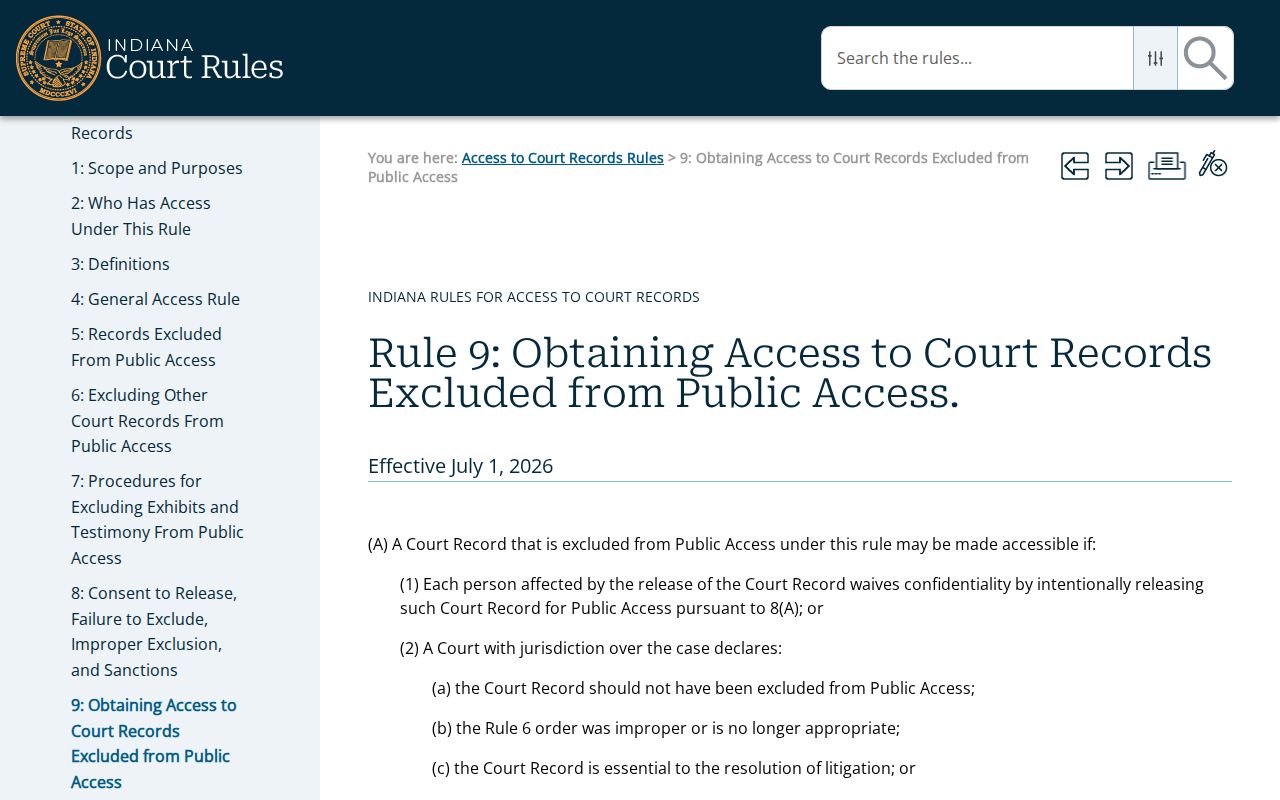
A Rule 9 request asks for more than an ordinary APRA request does. The person seeking the excluded record must identify it. The person must also explain the extraordinary circumstances or public-interest basis for access, address possible harm or prejudice, and give notice where required. A response period follows, then a written court order. The court weighs the stated grounds and the risk of harm. It may limit how the record gets used even after granting access. The Public Access Counselor can field APRA questions. But only the court can decide whether a sealed or excluded Scott County court record opens through this process.