
Scott County Court Docket Searches
For a Scott County court docket, the main online starting point is MyCase. It is the state of Indiana's public case search. It draws on Odyssey data from both Scott Circuit Court and Scott Superior Court. No account is required for public information. Be aware the state itself cautions that MyCase is not the official court record. It is a finding tool, not the file itself.
An exact cause number makes any Scott County docket search far easier. Without one, a party-name search offers first, middle, and last name fields. It adds a sounds-like option and a trailing wildcard. Court and case-type filters help cut down false matches. If a case does not appear online, call or visit the Scott County Clerk, mail or fax a focused request, or use the applicable public-record process. The clerk accepts no email requests.
- Open MyCase and choose the Case or Name search.
- Enter one identifier, or search a name and narrow to a Scott County court.
- Verify the court code, case type, filing date, parties, and case status.
- Read CCS events and settings without assuming each line is a document.
- Confirm current dates or balances and request official copies from the Clerk.
Scott County MyCase Search Fields
Three tabs organize the public search: Case, Name, and Attorney. A cause number, citation number, or cross-reference number goes in the Case tab. Officials recommend one identifier at a time. The Name tab handles both individual and business searches. Its sounds-like tool cannot pair with a wildcard.
| MyCase field | Best Scott County use |
|---|---|
| Cause number | Use the full number; hyphens and leading zeros may be omitted. |
| Court | Select 72C01 Scott Circuit or 72D01 Scott Superior. |
| Party name | Try exact spelling, then sounds-like or a trailing starts-with wildcard. |
| Status | Choose All, Open, or Closed to limit results. |
| File dates | Use beginning or ending dates to narrow a common name. |
Results cap at 1,000, and a CAPTCHA may appear. MyCase is not a bulk data service. Indiana steers large structured requests to the Office of Judicial Administration instead of automated collection from the public search.
Court Dockets: What They Show
Indiana's official dated event record goes by the name Chronological Case Summary, or CCS. A Scott County court docket can display the case header, public parties, attorneys, charges or claims, filed events, hearings, court orders, financial entries, and disposition. Exactly what appears depends on the case type and access status.
| Cause Number | Court code, filing year and month, case type, and sequence. |
|---|---|
| Case Header | Scott court, type, filing date, status, and public caption. |
| CCS Events | Dated filings, notices, settings, rulings, and converted entries. |
| Hearings | Setting type, date, time, court, judicial officer, and result when public. |
| Documents | Public title and link, or a signal that the item is unavailable or excluded. |
| Disposition | Dismissal, judgment, sentence, satisfaction, or other final action. |
Not every CCS line is a document. Some entries are administrative events, notices, hearings, payments, or rulings. When a link is missing, the public item may simply need to be requested from the Clerk.
Scott County Docket Codes
Every Scott County court docket number opens with a local court identifier. 72C01 marks Scott Circuit Court. 72D01 marks Scott Superior Court. The segments that follow usually carry the filing year and month. A case-type code and a sequential number follow. A pattern like 72D01-YYMM-SC-##### illustrates the small-claims format; it is not a real case.
- CCS
- The Chronological Case Summary, which records dated case activity.
- RJO
- The Record of Judgments and Orders, used for qualifying orders and judgments.
- IF
- An Indiana infraction case code often associated with traffic matters.
- SC
- A small-claims case code routed to Scott Superior Court.
- EFSP
- An electronic filing service provider, which is a filing channel rather than a public search.
Converted data sometimes shows older events without a linked image. If an entry's wording or date truly matters, verify against the original Scott County file.
Scott County Courts and Their Dockets
Both of Scott County's courts of record sit in one courthouse. A single elected Clerk structure serves them. Under current local rules, criminal cases go to Circuit Court. Superior Court handles most civil, domestic-relations, small-claims, eviction, ordinance, and adoption categories. Estates, juvenile matters, mental-health cases, tax cases, and support matters follow the detailed allocation rules instead. The Scott County courts directory lists each court and the Clerk's contact information.
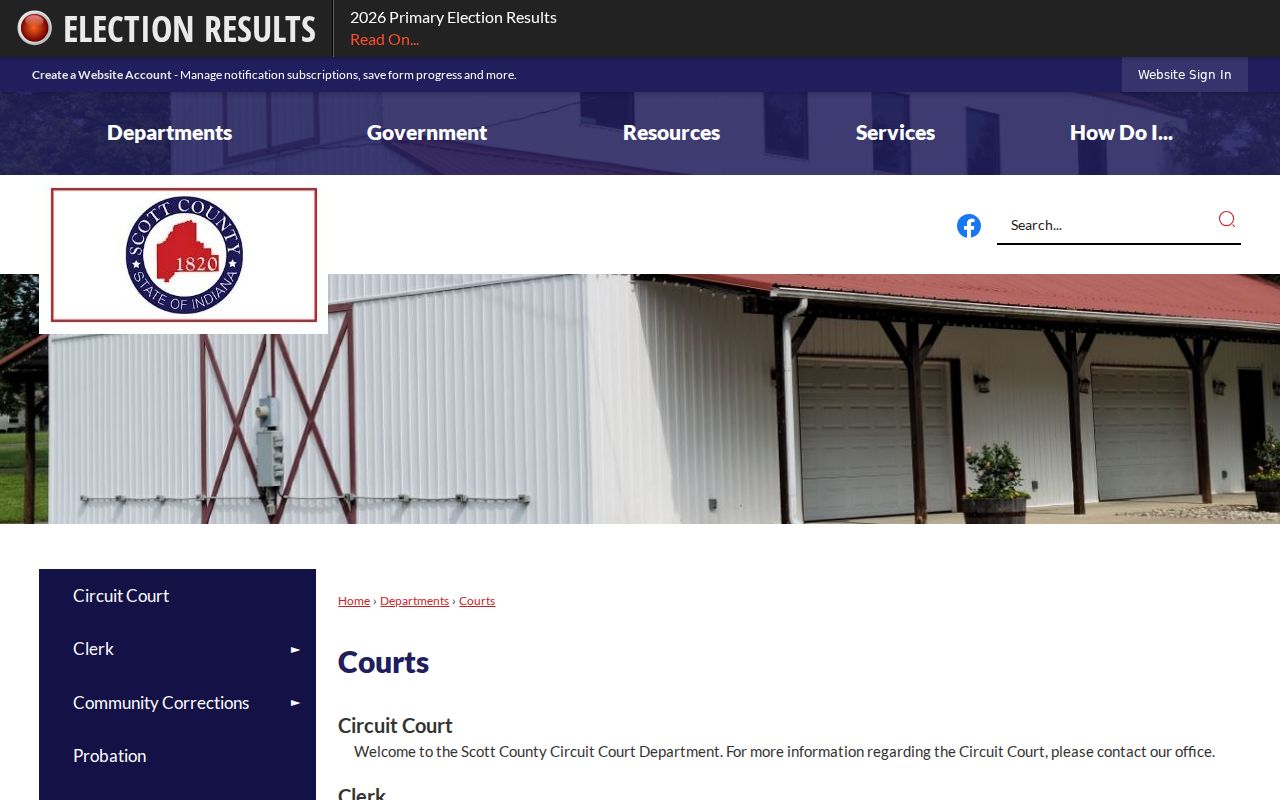
That directory is handy for confirming an office and suite before a visit. For telling which court owns a Scott County court docket, nothing beats the cause number.
| Court or office | Main docket role | Access route |
|---|---|---|
| Scott Circuit Court | Criminal and allocated estate, juvenile, mental-health, tax, and support matters | MyCase court 72C01, Clerk, or Circuit Court |
| Scott Superior Court | Most civil, domestic, small-claims, eviction, ordinance, and adoption matters | MyCase court 72D01, Clerk, or Superior Court |
| Scott County Clerk | Official files, copies, certification, fees, and request routing for both courts | Counter, phone, mail, fax, and public-record request |
Scott County Courthouse Docket Route
You will find the Scott County Courthouse at 1 East McClain Avenue in Scottsburg. The Clerk sits in Suite 120. Scott Circuit Court is in Suite 212, and Scott Superior Court is in Suite 252. Each office lists its own phone number and hours. Know the right court before traveling. The Indiana Historical Bureau courthouse marker recounts how the building developed.
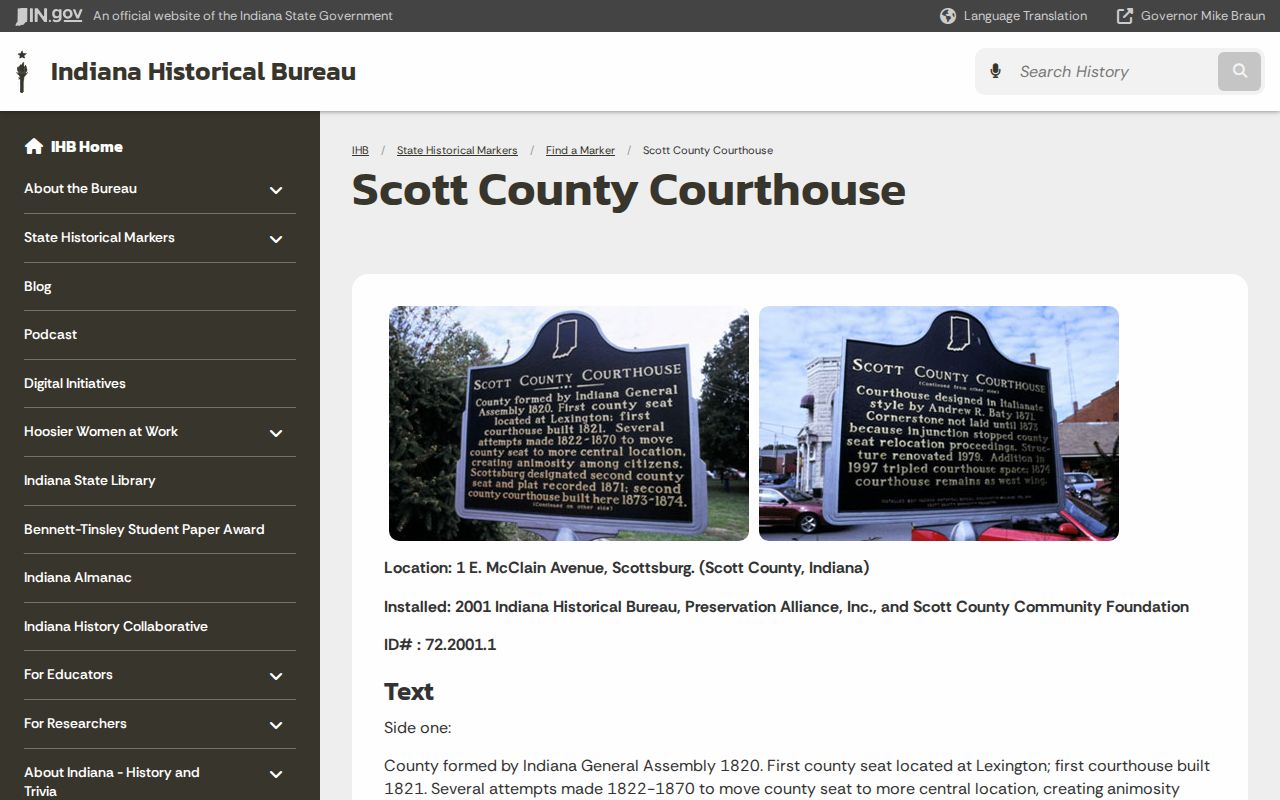
The 1874 courthouse still stands as the west wing. A 1997 addition expanded the complex around it. That layered history explains why one address holds several distinct court and records suites. An older sheriff notice described east-side entry, bag checks, and metal-detector screening. It also listed device restrictions on the second floor. Rules change, so verify before you arrive. Carry only what your Scott County court docket request requires.
Court Dates and Settings in Scott County
A public setting should name the court, date, time, and hearing type. Location appears too when those fields are available. Pull up the cause number in MyCase. Read both the settings area and the recent CCS events. A continuance request alone moves nothing. The court must act on it, and the new setting should then be confirmed. Scott County posts no separate daily calendar, ICS feed, or "today's cases" page. So a case-based lookup plus direct confirmation is the reliable chain. When a date is missing, recently changed, or unclear, call the maintaining court or Clerk. The Scott County Court Schedule walks through the local date-check process in more depth.
Scott County Docket Technology Layers
Scott Circuit and Superior Courts came onto Odyssey on July 11, 2011. MyCase is the public viewing layer for that Odyssey and converted data. A separate layer, the Indiana Electronic Filing System, serves parties and lawyers. It works through certified providers. The official record still lives with the Clerk and court.
E-filing in Scott County opened for voluntary filing on September 22, 2017. It became mandatory for applicable represented filers on November 21, 2017. Those dates explain why an older Scott County court docket may mix paper, microfiche, converted, and electronic components. The state publishes no fixed Scott refresh interval.
The Indiana judiciary's Scott County page gathers local court information. It also places the county in Judicial District 23.
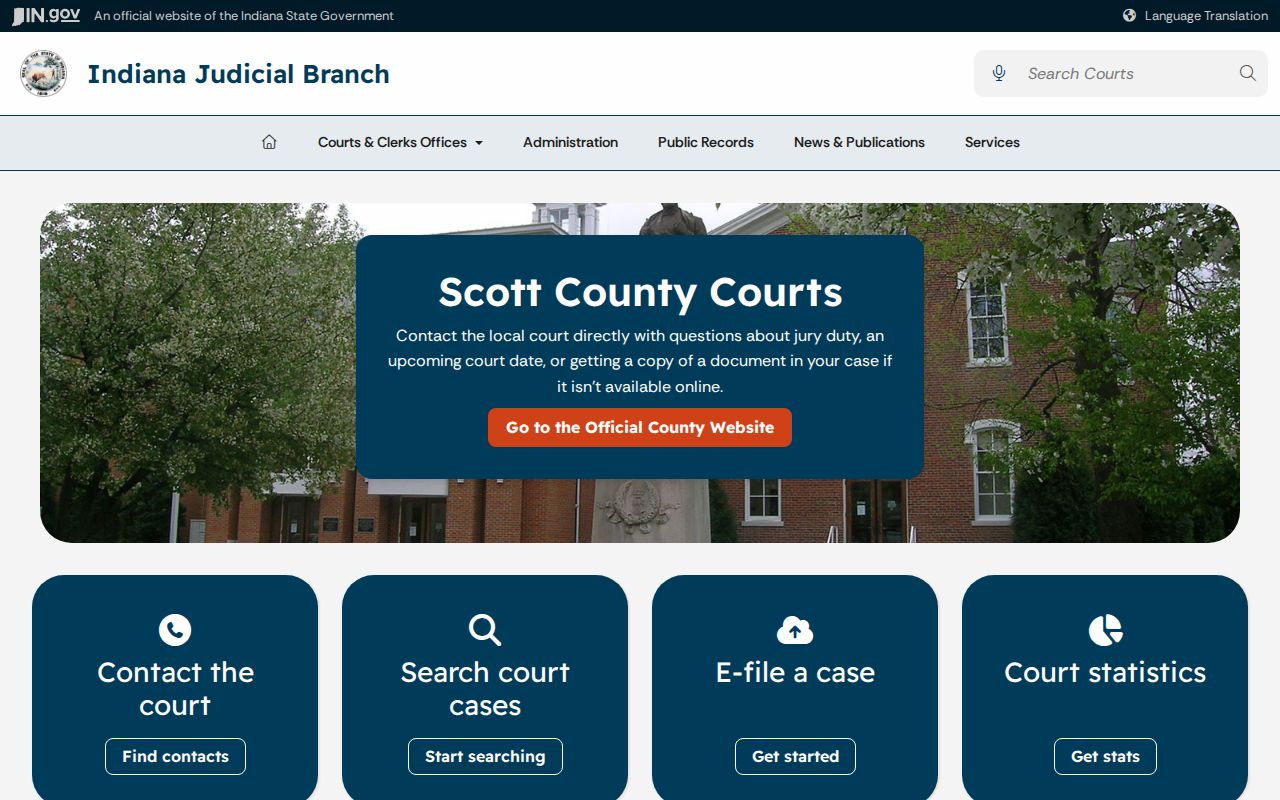
That state page is worth checking for current local rules. It does not replace MyCase or the Clerk's official Scott County file.
Docket Access Under Indiana Law
Indiana law starts from openness. The Access to Public Records Act and the Rules on Access to Court Records share that baseline, then carve out exclusions set by law, rule, or court order. For a Scott County court docket, that means several practical doors. You can run a docket search in MyCase, read a public file at the Clerk's counter, call the office for routing help, or send a narrower request by mail or fax. Whatever route you choose, name what you want: the court, the cause number, the case type, the record itself, your preferred format, and whether you need certification.
Key access rules: I.C. 5-14-3-3 addresses requests and responses. I.C. 5-14-3-8 addresses copy fees, while I.C. 5-14-3-9 addresses denials. ACR Rule 4 states the general court-record access framework. ACR Rule 5 lists excluded information, and ACR Rule 9 governs requests to open excluded records.
Timing follows the channel you use. Ask in person or by phone, and state guidance calls for a response or acknowledgment within 24 business hours. Mail, fax, or electronic requests get seven days, though the acknowledgment may set a later date for producing the record.
Scott County Restricted Docket Signals
Restricted cases rarely vanish from view. A cause number, a case shell, or an exclusion marker can stay on the docket. The document behind it stays hidden. Juvenile, mental-health, protection-order, adoption, guardianship, some domestic-relations, expunged, sealed, and in-camera records all call for care. Protected identifiers get redacted. And a blank search result never proves no Scott County court docket exists. Form ACR serves one job: letting a filer flag an excluded document. It also lets the filer state the legal ground. It is not a request form for the public. If you want an excluded record, ACR Rule 9 governs the verified written process. That includes stated grounds, required notice, a chance to respond, and a court decision. Do not try to rebuild protected text from another entry or a cached copy.
How the Clerk Keeps Docket Records
One office anchors nearly every docket request. Michelle Shelton, the Scott County Clerk, handles records and filing for both trial courts. Ask her staff for a specific public CCS, an order, a judgment, a pleading, a transcript route, or a certified copy, and give the court and cause number when you have them. The Clerk can also tell you whether an item sits with another office or is excluded from the court records. The official Scott County Clerk page posts office details along with the current copy charges.
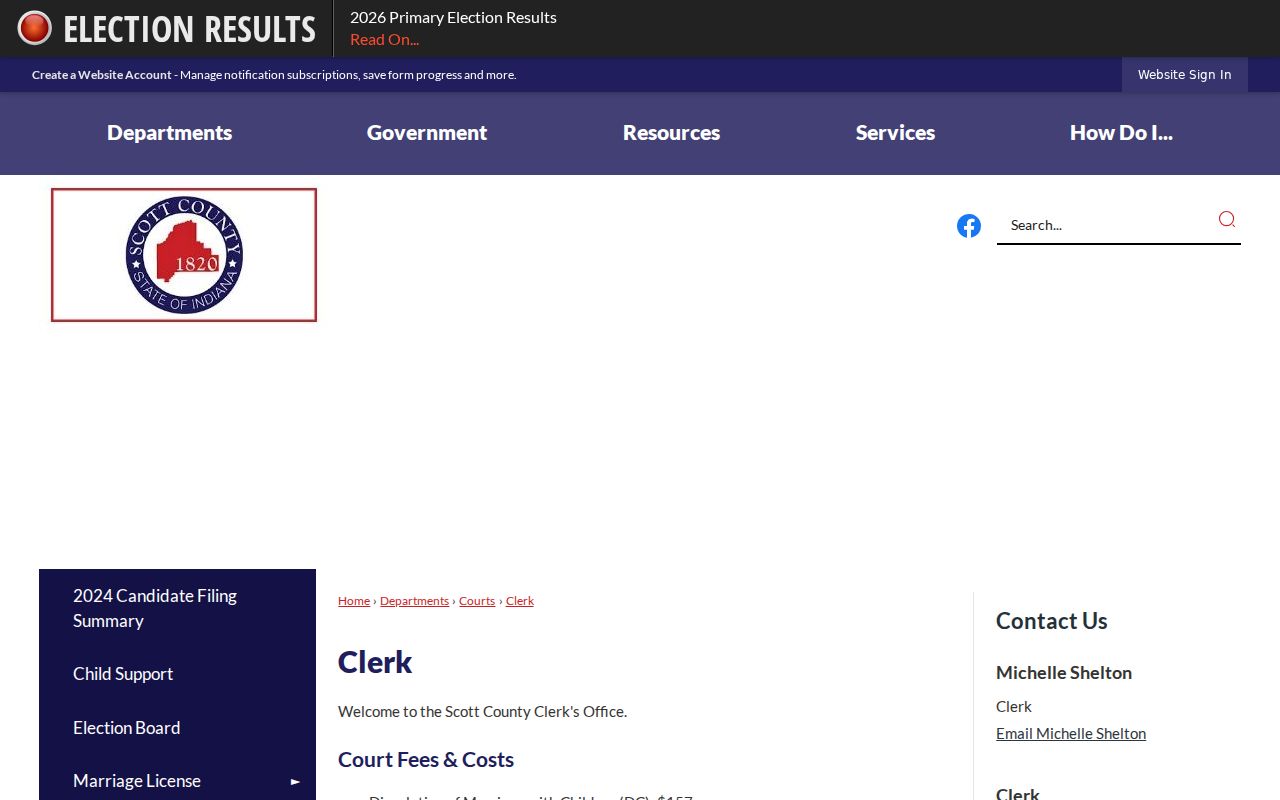
The Clerk's published schedule keeps it simple. Plain copies and CCS pages run $1 per page, certification adds $2, and child-support payment history costs $1 per page. Bring a card or cash, since personal checks are not accepted.
Michelle Shelton, Scott County Clerk
1 E McClain Avenue, Suite 120
Scottsburg, IN 47170
Monday through Friday, 8:30 a.m. to 4:30 p.m.
812-752-8420 Fax: 812-752-5459
| Scott County record item | Published charge |
|---|---|
| Plain copy | $1 per page |
| CCS copy | $1 per page |
| Certification | $2 |
| Child-support payment history | $1 per page |
Scott County Problem-Solving Dockets
Local rule LR72-CR00-18 confirms a problem-solving court framework in Scott County. It authorizes a $100 administrative fee per admission. It adds $50 per month starting with the second month. Hardship and other listed circumstances allow waiver by court order. None of that proves anyone's eligibility for a specific program. The county publishes no standalone program page, current program name, referral form, treatment provider, or meeting calendar. Take a live question to Scott Circuit Court or the Clerk. Check the statewide directory before naming any program. Keep one caution in mind: confidential treatment data does not become public just because a CCS mentions a program event.
Scott County Docket Rules Changed
Scott County's docket rules have just moved. Proposed allocation amendments went up on October 20, 2025. The Indiana Supreme Court approved changes to LR72-AR01-1, LR72-AR01-4, and LR72-TR79-12 in December 2025, effective January 1, 2026. The current 19-page local-rule edition controls today's routing. Why should a docket searcher care? An old allocation summary can steer a case to the wrong court. The amendments did not add a new Scott County court docket portal, so public case lookup still runs through MyCase while the official file stays with the Clerk and the court. Whenever a case type sits near an exception, confirm the current rule first.
City-by-City Court Dockets in Scott County
Two incorporated cities make up Scott County in the cited official geography sources: Scottsburg and Austin. Neither one runs its own city or town court. That holds under the current Indiana directory and the Odyssey court list. Still, a city police citation or ordinance issue can land in a county case. Search the assigned 72C01 or 72D01 cause number. You can also turn to the Scott County Clerk when no number is in hand. The 2020 Census reference figures rank Scottsburg first at 7,345 residents. Austin comes second at 4,064. Those numbers explain the ordering and nothing more. They are reference numbers, not current population estimates for either city. City administrative records stay with each city. Filed cases roll into the Scott County court docket system. Scottsburg holds the county seat as well. So an informal Scottsburg docket search usually leads to the county courthouse. The city ordinance page answers city-code questions, but it is not a CCS search. Scott local rules assign ordinance-violation categories to Superior Court. Before the court route is certain, a citation still needs its cause number and issuing-agency details. Austin follows the same county roll-up. Its official city site is the right start for municipal administrative records. Any filed judicial case belongs in the Scott Circuit or Superior workflow. Austin publishes no court calendar. It offers no public docket portal or municipal e-filing system of its own. When a citation lacks a cause number, the Scott County Clerk can search from the citation details. The clerk then identifies the right court record.
Scottsburg Court Records
County seat and courthouse city. Search Scott Circuit or Superior rather than expecting a separate municipal docket.
Austin Court Records
Scott County's other incorporated city. City cases route through the county court-code and Clerk workflow.
Map and Directions to the Scott County Courthouse
The Scott County Courthouse in downtown Scottsburg holds both Scott Circuit Court and Scott Superior Court, along with the Clerk's Office that keeps the case file for each. The Clerk's Office is in Suite 120, Circuit Court keeps its own office in Suite 212, and Superior Court's office is Suite 252. Circuit is assigned criminal cases and several specialized categories under the current local rules, while Superior handles most civil, domestic-relations, small-claims, eviction, ordinance, and adoption matters. Confirming the suite and court before arrival saves a trip back to the counter.
Scott County Courthouse
1 East McClain Avenue
Scottsburg, IN 47170
812-752-8420
Monday through Friday, 8:30 a.m. to 4:30 p.m.
The Scott County Sheriff's office reported in 2020 that entry runs through the east side, handicapped-ramp entrance, where bags are searched and a metal detector is used; that notice predates the current local rules, so calling the Clerk at 812-752-8420 first confirms today's entry procedure. Recording, photography, and broadcasting are prohibited on the entire second floor except in the prosecutor's office. No courthouse parking or ADA-access details have been published, so a call ahead is the safest option for visitors with specific needs.